
GEOSPATIAL INTELLIGENCE
GEOINT-ISAC


GeoSpatial Intelligence – Discover the Advantages
In today’s ever-expanding global threat landscape, the importance of timely relevant, and accurate (physical, geospatial (undersea terrestrial earth, climate, space), cyber and cyber-physical) actionable intelligence is vital to enable and sustain critical infrastructure and community resilience.
Geospatial Intelligence (GEOINT) is vital to strengthen critical infrastructure resilience providing a comprehensive , multi-dimensional situatonal awareness understanding of the environments in which essential, complex, and interdependent systems operate, including supporting the ability to Identify, Detect, Respond, and Recover from security threats.

GLOBAL CRITICAL INFRASTRUCTURE & COMMUNITY RESILIENCE GEOSPATIAL INTELLIGENCE
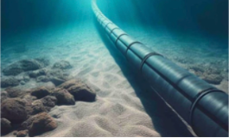
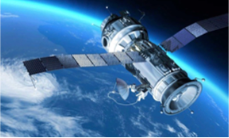
From the Seabed to Terrestrial Earth to Climate to Space, Geospatial Intelligence is a foundational to protecting critical infrastructure and strengthening community resilience.
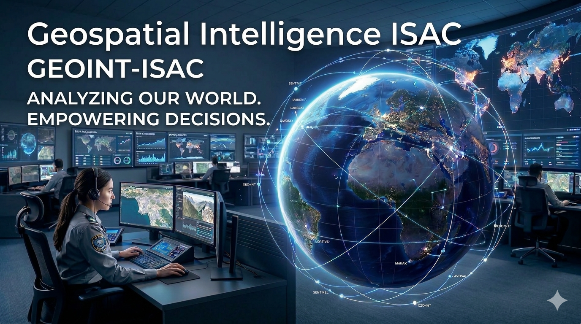
The Geospatial Intellience Information Sharing & Analysis Center (GEOINT-ISAC) is the trusted platform where government, public-private critical infrastructure owners and operators collaborate and reply upon advanced geospatial data and anaysis to share insights, identify risk, share situational awareness intelligence coordinate response for impacts to critical infrastructure and communities.
The GEOINT-ISAC collects, analyzes, interprets, and shares geospatial data deriived from location-based data (satellites, sensors, mapping systems, enironmental monitoring), and collective public-private intel information sharing into timely operational insights deivered in a form decision-makers can act upon – Actionable Intelligence.
By advancing shared situational awareness and cross-sector collaboration, the GEOINT ISAC also supports emergency management, disaster preparedness, and response operations. Geospatial intelligence enables decision-makers to anticipate hazards, coordinate resources, and deliver timely, data-driven insights that strengthen disaster response and recovery.
Actional Intelligence – Global Transparency – Decision Advantages – Describe, Assess, Visually Depict – Situational Awareness, Advisories, Alerts, Predictive and Real-Time Analysis and Reporting, Infrastructure Protection, Community Resilience, Emergency Management, Disaster Recovery, Public-Private Incident Response & Communications.
GEOINT-ISAC – DIVISION INTERNATIONAL ASSOCIATION OF CERTIFIED ISAOs (IACI)
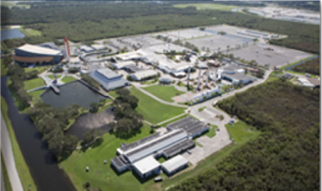
The GEOINT-ISAC is a Division of the Interntional Association of Certified ISAOs (IACI). IACI is the trusted center-of-gravity operationalizing public-private threat and defensive measures ‘actionable’ intelligence information sharing, analysis, and response within and across critical infrastructure supported by best practive and education.
GEOINT-ISAC HEADQUARTERS
IACI-CERT, International Association of Certified ISAOs (IACI)
Center for Space Education
NASA/Kennedy Space Center, Florida
IACINET CRITICAL INFORMATION SHARING INFRASTRUCTURE
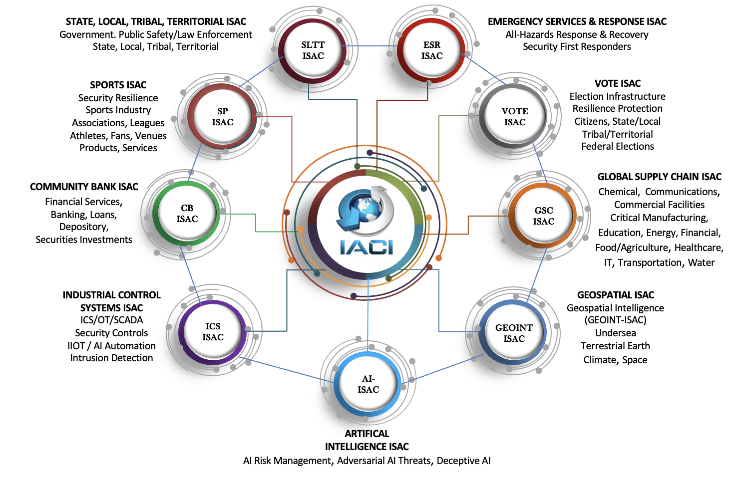
The GEOINT-ISAC represents a core component of the IACI Security Resilinece Information Sharing Infrastructure representing collective public-private critical infrastructure sectors and sub-sectors cooperation, coordination and collaboration…BREAKING DOWN LONG-STANDING BARRIERS & SILOS
Join GEOINT-ISAC
Joining a Geospatial Intelligence Information Sharing and Analysis Center (ISAC) offers organizations a strategic advantage by providing a collaborative ecosystem to combat sector-specific physical and cyber threats. In an era where critical infrastructure—from satellite constellations to maritime logistics—is increasingly targeted, a Geospatial ISAC serves as a vital hub for real-time threat intelligence, allowing members to share indicators of compromise and “ground truth” observations that might otherwise remain siloed.
By participating, your organization gains access to a specialized repository of actionable data, including satellite imagery analysis, GPS interference reports, and vulnerability assessments tailored to geospatial technologies like GIS and remote sensing. This collective defense model not only accelerates incident response and risk mitigation but also fosters professional growth through technical exchanges, benchmarking, and cross-sector coordination with government agencies like the NGA.
Ultimately, membership transforms a single entity’s situational awareness into a shared, robust security posture that protects both proprietary assets and the integrity of global location-based services.